

[Continued]
Cicadahood is the operating principle of the Venice Biennale.
There’s another distinction to be drawn, that cuts across my previous idea of a hub from which the valuation of objects and projects radiates. It’s the distinction between the curated and the staged. In my own artistic practice I’ve been more interested in staging than in curating. The Biennale is, for the most part, about curating.
Curating focuses on the validation of the work of an artist or a group of artists as a whole, a cogent and impervious unit. Anything that distracts from this validation is an impediment to be overcome or eliminated. That includes all obstacles of place, of context, of interpretation.
Art jargon is a constitutive part of this. Many years ago I studied for a Master’s in Art Criticism with Donald Kuspit, the Balzhargon in person. Luckily I was passed over for the advanced seminar. On completion, postulants were handed a freelancer’s job at a then-prestigious arts mag. The job involved writing ten-line reviews of artworks they’d never seen, based on press releases from galleries that advertised with the journal, at $50.00 a pop. As I’ve written elsewhere, the main advantage of art-jargon is its abdication of accountability.1Jargon is the curator’s friend for its posture of transcendent universalism. One size fits all.
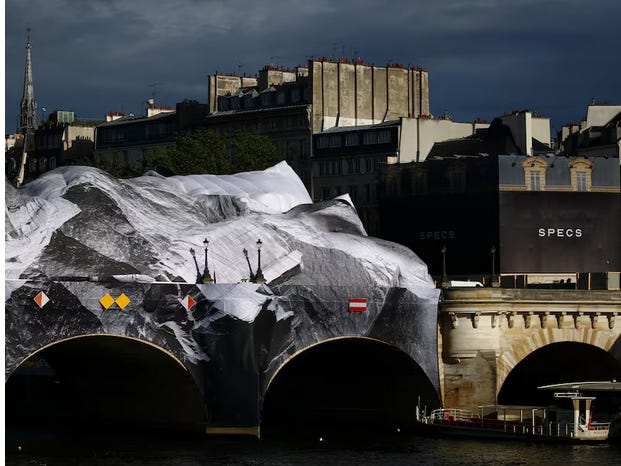
And jargon’s only one form of this particular type of suppression. In 1986, Joëlle Kauffmann placed a display on a barge by the Pont-Neuf in Paris, calling for the release of her husband Jean-Paul, who’d been kidnapped and was then being held in Lebanon—he was released in 1988, you’ll want to know. Meanwhile, Christo, who was in the process of wrapping the bridge in gauze, respectfully objected:
“Please understand, Madame, that we are celebrating joy while you are showing tragedy, that’s unfortunate. Perhaps you should move on further.”
« Vous comprenez, madame, nous faisons la fête de la joie, et vous, vous nous montrez le drame, c’est fâcheux. Vous pourriez peut-être aller plus loin. »2
Perhaps there’s some kind of objective measure of the degree to which any given display of art in any given era suppresses the social and political reverberations of its presence. The logic of Modernity demands the erasure of the past with all of its burdens. If not erasure, suppression. If not suppression, supersession:
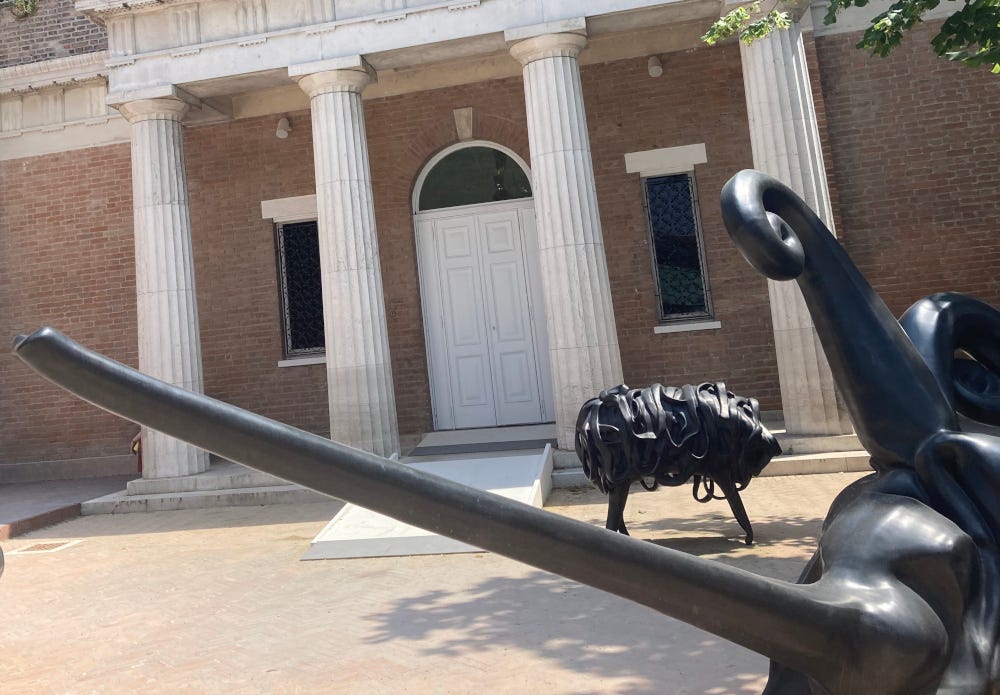
The French critic Etienne-Jean Delécluze called these public practices “Saturnalia:” He was writing about the popular displays promoted by the Directoire in the period of reactionary consolidation of the French Revolution, 1794-1799. These Saturnalia were, are still, political and social mobilizations in reverse, substituting aesthetic pleasures for social connection.3 In view of this, the outrage that’s been ramped up around the sculptures of Alma Allen on display at the American Pavilion is beside the point. Allen’s work is no worse or better than the “Median Art” it is, the kind of thing that’s put up in the middle of Park Avenue — okay, worse than Sean Scully and on a par with Carol Bove. Allen’s work is there to fill a gap that needs to be filled with the least amount of social or political commitment. He’s been chosen, not for his loyalty in any aesthetic sense, but because no curator or artist is going to risk their reputation by allowing themselves to seem to be endorsed, even tacitly, by the Trump Regime.
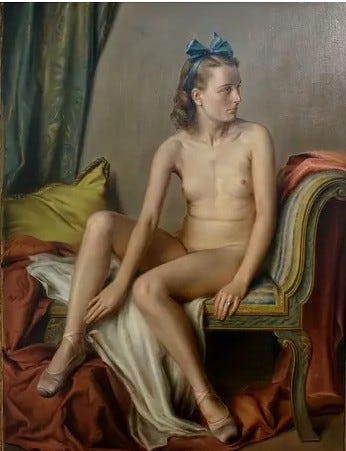
I didn’t visit the Austrian Pavilion because I was warned in advance that there would be naked people on view, that even standing outside the pavilion might expose me to the sight of naked Austrians. This is ‘sixties Actionism all over again. Or something else. Or both. Hey, kids. Can you say “apotropaic?”
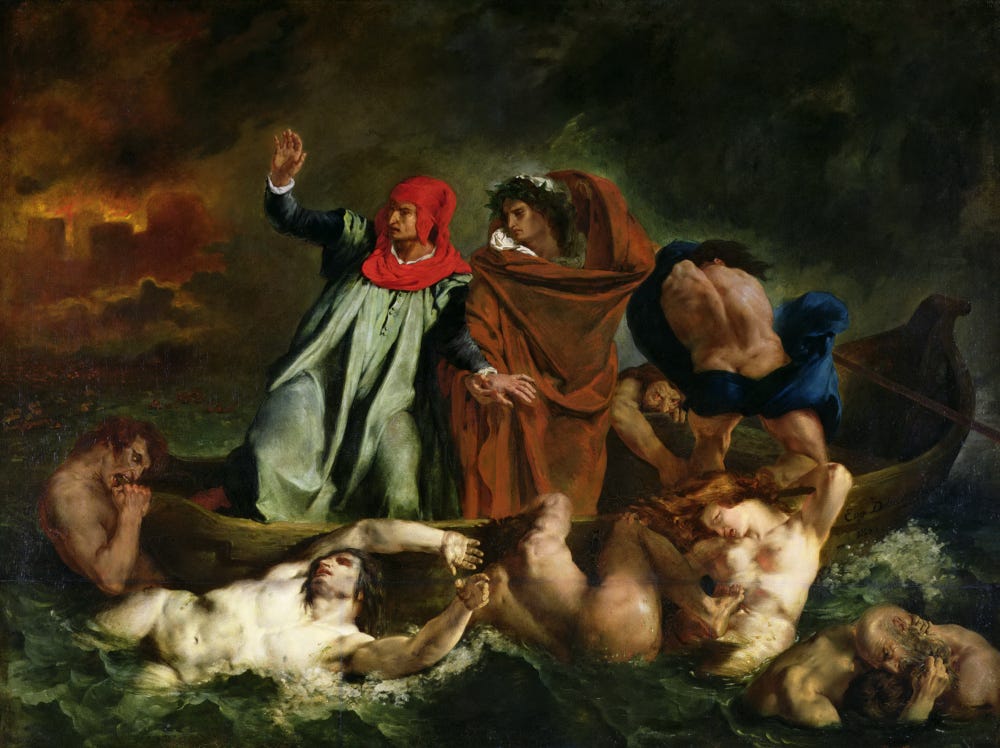
Let’s try something else. Let’s try to dredge up an image of the real world that in turn allows us to articulate our own response to the real world, as Osip Mandelstam had learned to do from Dante:
“A quotation is a cicada. Its natural state is relentlessness. Having once seized the air, it will not let go.”4
Cicadahood as the operating principle of the national pavilions at the Venice Biennale: visual configurations that are not used as means to wider views, merely reiterated, obsessively, as a means of not letting go. Take the exhibition in the Spanish Pavilion, which does not articulate or state the given space as much as it repeats its pattern:
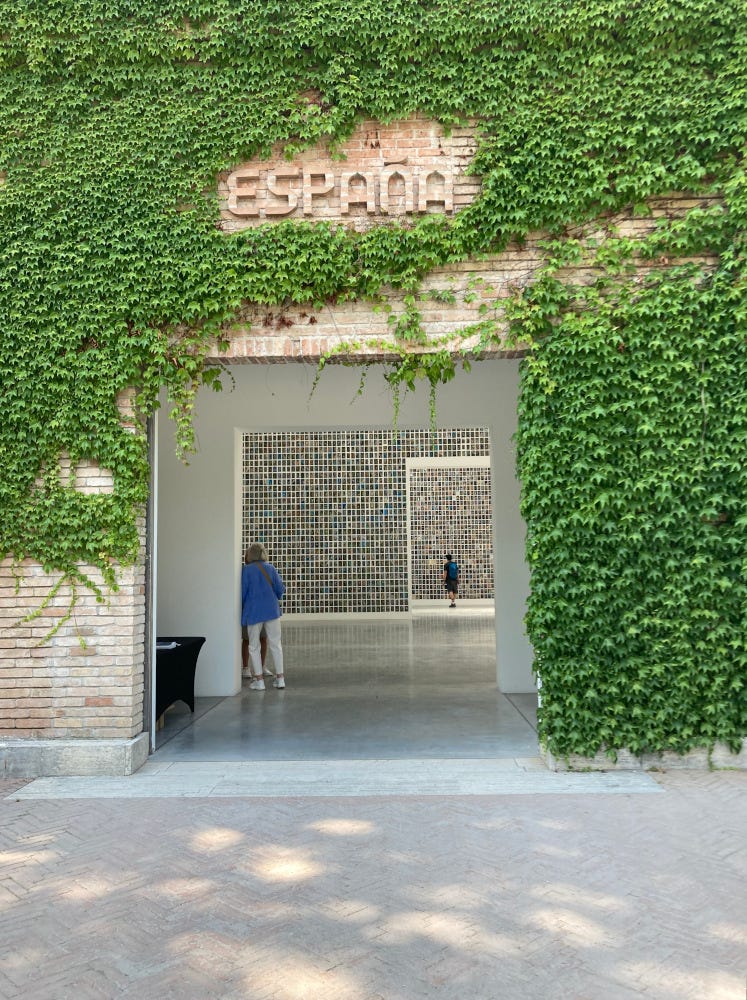
What the installation at the Spanish Pavilion does to the Spanish Pavilion, likewise, the installation at the Belgian Pavilion does for lettering, meaning: nothing.
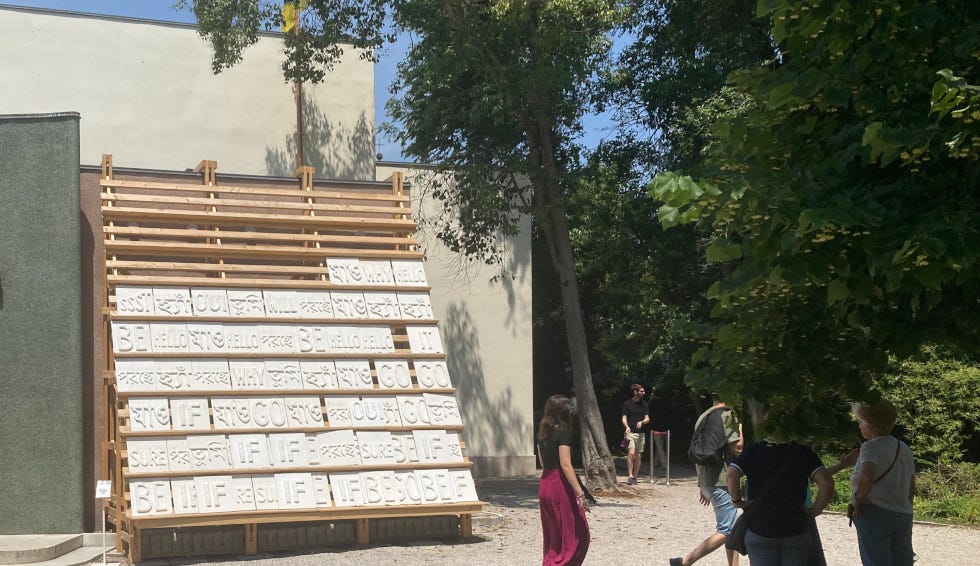
The fantasy that lettering represent a transparent conveyance of language is an old one— a guy named Derrida blew a lot of smoke around that one, and there’s a very large amount of that particular smoke floating around Venice nowadays. Letterforms, you see, do not distort language, they only reproduce the world as it is, honest. And the world as it is is as it is amirite?
There’s a lot more than this in Venice, of course; but there’s a lot of this as well, lost souls in a sea of Empiricism, incapable of dredging up any sense outside of a senseless world to which they owe their survival, hoarding the space they occupy to guard against intruders:
WOID XXV-27c
June 6, 2026
To be continued.
Paul Werner, Museum, Inc. Inside the Global Art World. The Author’s Cut (The Orange Press, 2014), pp. 26-27.
Pierre Desproges, Chroniques de la haine ordinaire (Paris: Seuil, 1987), p. 27.
Etienne-Jean Delécluze, David. Son école & son temps [1855] (Paris: Macula, 1983), p. 429; see also Paul Werner, « Les Saturnales de la démocratie », in Serge Chaumier, ed. Expoland. Ce que le parc fait au musée : ambivalence des formes de l’exposition (Paris: Complicités), pp. 151-161.
Osip Mandelstam, Commentary on Dante [«Разговор о Данте»], II, circa 1935.