
The Man with a Urinal
Marcel Duchamp at the Museum of Modern Art

The scandal of Duchamp, as far as the critics are concerned, is not that the shovel is transfigured into a work of art; it’s that the work of art remains a shovel for all that.
April 12 through August 22, 2026
Marcel Duchamp
Museum of Modern Art
There’s a hoary old joke about men confined in jail—or a barracks or a submarine, whatever, and they’ve grown so bored with the same jokes that they’ve numbered them all. And there’s one man among them who from time to time cries out, say, “78!” and everybody bursts out laughing.
Then there’s another man who shouts out numbers, and all he gets is dead silence in return. Finally, one of his mates explains to him: some people just don’t know how to tell them.
That’s the first thing and the last you’re going to need to know about Duchamp: anybody can make a work of art and most everybody does; few know how to make it work. The Duchamp retrospective at the Museum of Modern Art is like an art school thesis show where the candidate is expected to display their competency, with the difference that Duchamp, unlike an art school graduate, had the competency of a pro. Duchamp was very good at saying what art’s supposed to say. He knew better than anyone how to tell the joke called Art.
You can tell at once because the first room in MoMA’s sprawling show is devoted to Duchamp’s early work. By age fifteen he was producing the kind of stuff that lets everybody know you know what’s involved in the making of art:
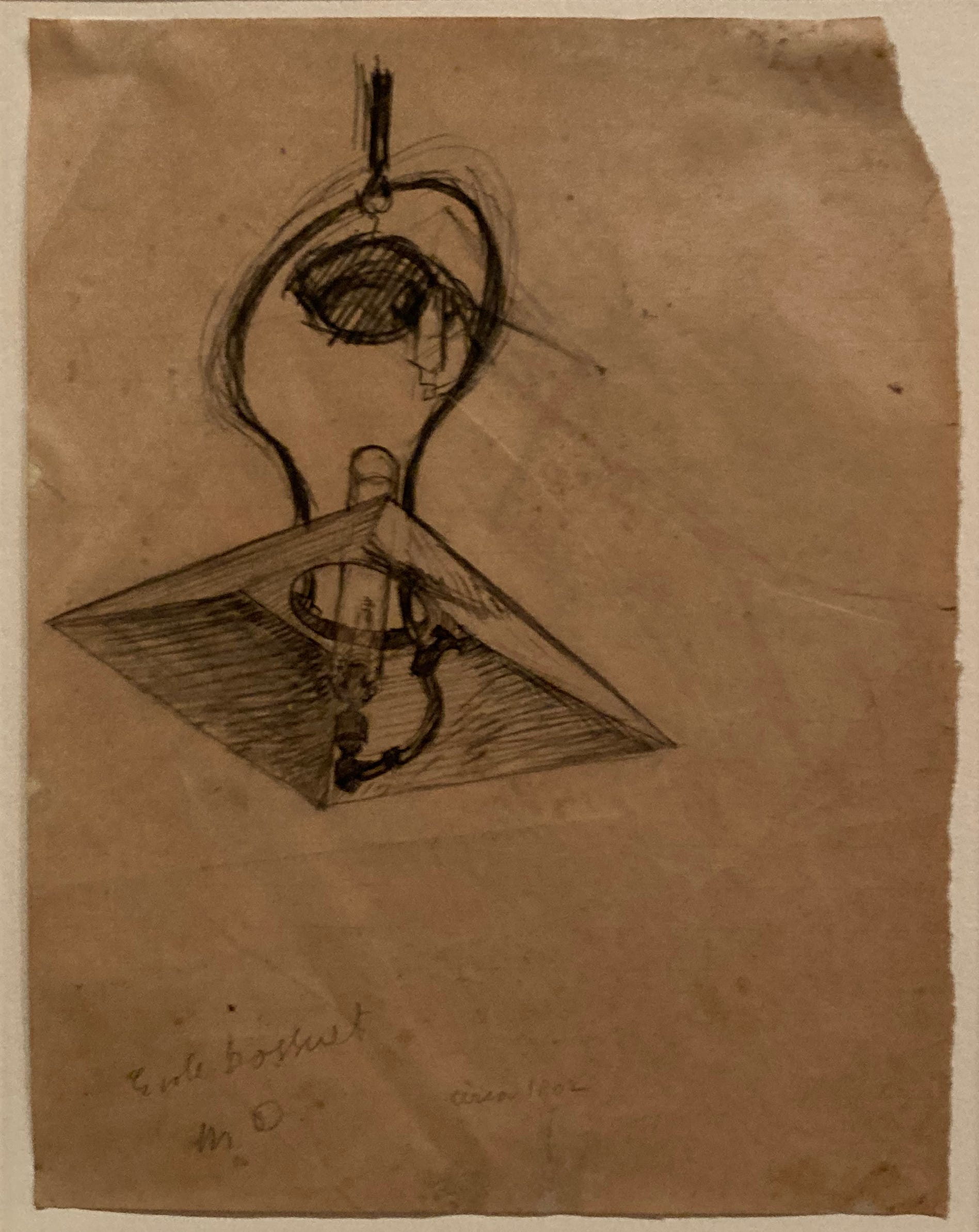
The signage claims this drawing was produced in 1904, but the signature says 1902 and gives the name of the high-school, possibly the teacher’s. In Duchamp’s time (and mine) the French educational system relied on rigid assignments based on quantifiable criteria, even in the Art class. Know-how was sanctioned over creativity; the system was designed to form technicians, not creative artists.
Duchamp’s particular genius was to get intensely creative with the technical know-how, and you can follow this approach throughout his career. He reminds me of another artist who twisted assignments into pretzels, Keith Haring at the School of Visual Arts. With Duchamp the teenager’s questioning of perspective morphs into a sharp, consistent questioning of perspective as a form of subjectivity, which (if you wish), you can trace back to the Late Classical meaning of the word per-spectiva: a mechanism that organizes forms in their relation to the beholder’s subjective view:
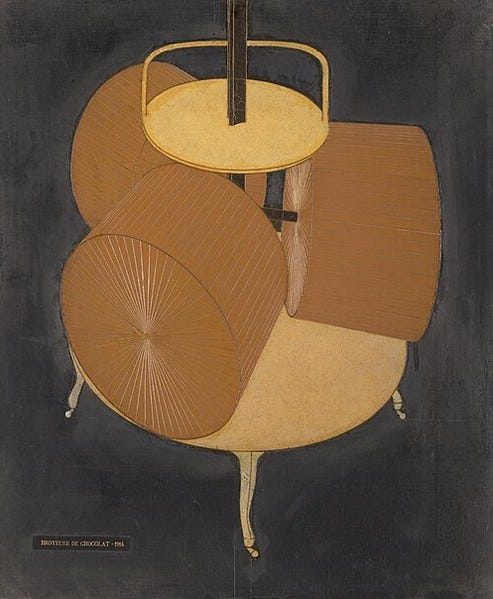
There’s more like that throughout, stuff about art as a social process, stuff about art as accumulation in space and time:
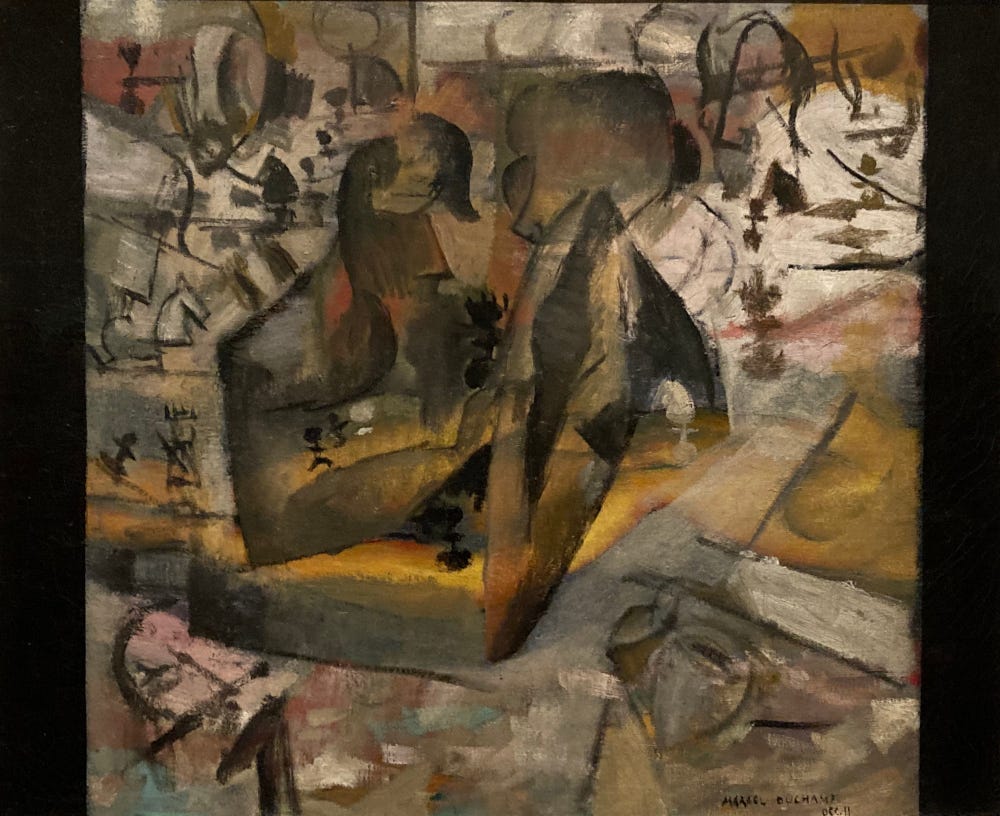
Seen one work, and you’ve seen one: the man was a Raphael in reverse. Duchamp was too efficient to let all of those ideas and conceptions go to waste; too proficient to stay with one. No-one could upend ideas and conceptions so efficiently, proficiently.
Marcel Duchamp. A regarder (l’autre côté du verre) d’un oeil, de près, pendant presque une heure (The Small Glass), 1918. Metropolitan Museum of Art.
Which brings us to the urinal, technically titled Fountain:
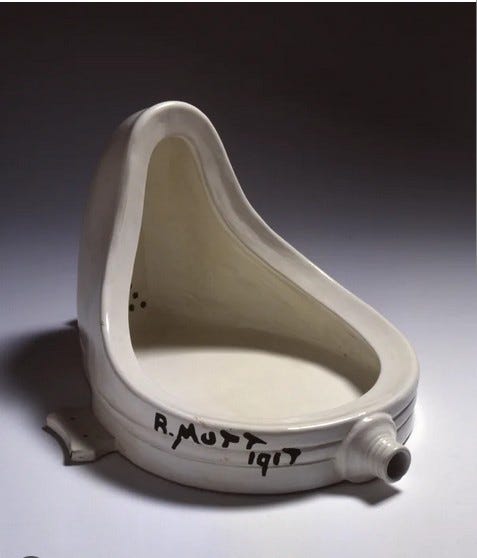
Arthur Danto, an artist turned philosopher turned critic and the author of The Transfiguration of the Commonplace, used to tell how he’d once submitted an article in which he compared the gleaming white porcelain of Duchamp’s urinal to Jesus at the [ahem] Transfiguration, whose “countenance was altered, and his raiment was white, and glistering” [Luke 9:29]; “shining, exceeding white” [Mark 9:3], the original Piss Christ. The comparison, Danto claimed, was withdrawn before publication; but I suspect there’s more shock than news to that story. The bleached bone of contention isn’t so much the Transfiguration in the biblical sense as Duchamp’s subversion of the philosophical conception of transfiguration itself. It’s the long history of the critical-philosophical conception of Art that overshadows, still, our appreciation of Duchamp, and of art in general.
As early as 1918 the French poet Guillaume Apollinaire claimed that the intended title for Fountain, shown the previous year in New York, was « Le Bouddha de la salle de bain », and the Buddha is as good a candidate for transfiguration as Christ — or is it transcendence? Apollinaire pointed out, with a touch of irritation, that the joke was old hat by then: the critics had learned nothing from a joke orchestrated by himself and others back in 1910, when a painting executed by means of a donkey tail had been shown at the Salon des Indépendants in Paris. Artists and jury, Apollinaire suggested, were in on the joke.1 Perhaps the visitors were, too. But the pressure on critics and philosophers to play the art-world insider had left them clueless.
Modernist Joke #45: “Everything changes, only the avant-garde remains the same.” With Duchamp’s Fountain, it’s the critics and philosophers who are stuck in time, as true today as it was then. In Europe, then America, from the 1900s on, the story of Art, especially among American philosophers like Danto and influential American critics like Clement Greenberg or Rosalind Krauss, told of Art moving towards a kind of purification, a gradual discarding of all but its essence, an Artworld Christ cleansed of His vulgar body. Through Art the Search for Truth would lead inevitably to the single, shiny Truth in the Sky, the Idea, as the German philosopher J. W. F. Hegel called it:
“Truth, in fact, is the Idea itself, such as it is thought.”
„Wahr nämlich ist die Idee, wie sie… solches gedacht wird.“2
The Truth of Art, therefore, was the Idea — the critic’s own. What these critics were proposing was, in fact, a grotesque distortion of the Hegelian notion of Aufhebung, a word that’s best translated as “sublation,” and that’s a low bar. Aufhebung is the process by which concepts are superseded through their apparent opposite, thesis-antithesis-synthesis and all that. Where the critics (Greenberg, Danto, Krauss e tutti quanti) depart from Hegel, is over the extent and meaning of Aufhebung. Hegel, in a significant entry to his Encyclopedia, speaks of
“the negative aspect of mental activity, by which this material is transmuted into mind and destroyed as a sensible.”3
Except that’s not what Hegel said, it’s what the English translation says he said. Here’s what Hegel says in the German original:
„Das Negative der Thätigkeit des Geistes, wodurch jener Stoff vergeistigt und als Sinnliches aufgehoben wird, verkannt und übersehen ist. Das Sinnliche ist in jener Stellung nicht bloss das empirische Erste, sondern bleibt so, dass es die wahrhaft substantielle Grundlage sein solle.“4
“The negating activity of the Mind, by which Substance becomes of the Mind and is transmuted as sensual, is misread and overlooked [by Condillac]. In this context, the Sensual is not merely treated as an empirical starting-point; but it remains so, as if it were the true substantive foundation.”
Hegel is saying that the sensual aspect of material objects is erroneously taken by Condillac, the eighteenth-century French philosopher, as the foundation of speculative reason, whereas to Hegel this sensual aspect, to the extent that it’s perceived by the viewer, has been already embraced and modified by the mind — that Tree in the Forest thang.
Of course any system fashioned in the tradition of Condillac, or Locke, or Hume or the rest of La Bande à Bonnot — any system based on British Empiricism or Danto’s Analytical Philosophy, that is, — would be hard put to grasp this. Hegel is in the process of arguing that one cannot claim a solid foundation for thought in material reality as it is: all objects of perception are to the mind as already apprehended.
And this is what Hegel means when he says, in his Aesthetics, that “the beauty of Art is that beauty which is born of the spirit [Geist] and born again” (die Kunstschönheit ist die aus dem Geiste geborene und wiedergeborene Schönheit).5 It’s an oft-quoted line that’s confused the Anglo critics, the philosophers and the aesthetically inclined since the dawn of Modernity, and that confuses them, still. Thus in 1975, T. M. Knox, in a footnote to his English translation of Hegel’s Aesthetics, comments:
“This is obscure. Bosanquet, in his translation of Hegel’s Introduction (London 1905), p. 39 suggests an allusion to ‘born of water and the spirit,’ but this must be wrong. Hegel means that we have beauty originated by man’s mind and also what is reproduced by his mind in his natural world.”6
Born of the water and the spirit is a quote from the Gospels [John 3:5] that’s usually read to signify spiritual rebirth through baptism. The footnote may well have inspired Danto, who heavily annotated his own copy of the Knox translation. Considering the “water” involved in Duchamp’s urinal, the meaning’s limpid.
At any rate the word Geist is notoriously hard to translate into English: something between Mind and Spirit, maybe “The Spirit of Thought.” In the hands of British moral philosophers like Bernard Bosanquet the fons et origo of Hegel’s thought, his Phenomenologie des Geistes (Variously translated as Phenomenology of Mind or Phenomenology of Spirit) becomes a phenomenology of the Spiritual: not of the Spirit that penetrates all of material reality but the Spiritual that stands against it. The same might be said of Danto’s approach to Art, and Greenberg’s, and Krauss’.
Hanna Monaghan, the Nantucket aesthete, tells of an encounter with an elderly Quaker woman. (Monaghan’s family was steeped in the tradition of American Quaker nonconformism.) When Hanna boldly proclaims that “Art is Beauty, Beauty, Truth,” the old Quaker responds in true Quaker fashion that Truth (and by extension Beauty), cannot be found in material objects, but only in inner faith.7 In Duchampian terms: is a Pissoire-as-Art transcendent, inhabited by the Spirit of Art from its very nature as a work of art, from its essential innate artiness, that is? Or, contrariwise, could a pissoire transcend mere Pissoirehood from the sensual qualities inherent in it as a physical object, gleaming white and so forth? These are the fault lines along which the reading and misreading of Hegel operate. Also, the setup for Duchamp’s joke. Do you know philosophers have no sense of humor? Ah yes, „Zur Philosophische Humorlosigkeit.“ Have you read my book?
Hegel is clear—okay, unambiguous. As is often the case, he’s going up against Immanuel Kant’s argument in the Critique of Judgment of 1790 — series of interlocked arguments, rather. For Kant, the material aspect of things lies
“…thick in the physicality of sensation […] , where it is simply directed toward pleasure, of which nothing remains in the Idea.”
„dicht in der Materie der Empfindung […], wo es bloß auf Genuß angelegt ist, welcher nichts in der Idee zurückläßt .“ [§52]
If Beauty is inherent (Wesentlich) in the sensible, as Kant has just proposed, and if the sensible is merely pleasurable, then how can Beauty be raised from the lowly objects and experiences of the sensible world? For Kant there is no answer. Whatever is available to the senses falls under the heading of Genuß: pleasure, the enjoyable, the object of consumption. And true Beauty, if it is to be one with Truth, cannot in any way partake of the material reality of things. Kant was a major influence on American nonconformist spiritualism, and therefore art-making and art appreciation. Somewhere, that old Quaker lady is nodding her bonnet.
Or that aging critic. Knox, in a note to his 1975 translation of Hegel’s Aesthetics, mistakenly applies Kant’s criterion to Hegel:
“A work of art is different from a photograph. Even if it portrays a shop, it is the appearance (Schein) which pleases us and is the essential thing, without our having any interest in the shop or what it sells. Consequently, with this Kantian doctrine in mind…” [Knox, n. 3, p. 4.]
Here Knox conflates Schein (the appearance of things and concepts to the mind), and sinnliche Schein, the sensual appearance of things, which is what distinguishes Hegel’s theory from Kant’s. For Hegel it’s the sublation of the sensual appearance of things by means of natural beauty (Schönheit) that allows for a second sublation by means of the subjective understanding of the Beautiful (Kunstschönheit), which in turn opens up the possibility of a philosophic conceptualization of the Beautiful in general, and Art in general as well. Beauty is nested (bewahrt) in the artwork that in turn is nested in the sensual world, Denn das Schöne hat sein Leben in dem Scheine: “For the life of the Beautiful lies in appearance.” 8
To Kant, all of this is a non-starter because Spirit lies, as it did for the elderly Quaker, outside of the realm of phenomenal perception, much as the artiness of an artwork, according to Danto, lies outside of the realm of perception. Since there’s nothing to distinguish a Brillo box in the gallery from a Brillo box in the kitchen (or a pissoire in the men’s room, you get the idea) the pissoire, from the very fact that there’s nothing to distinguish it, becomes “the evidence of things not seen” [Hebrews 11:1] or at least the evidence that things have not been seen by you and me. To Hegel, contrariwise, Spirit first appears in a raw sensible object, in which the observer perceives certain qualities, one of which is the Beautiful. Once those qualities are understood to harbor the concept of the Beautiful the artist or the observer elevates them to another level, that of the Beauty of Art from whence they are available to philosophical understanding in general. Where Kant saw two distinct and irreconcilable phenomena, the Pleasing (sensual) and the Sublime (abstract), Hegel saw two stages in the ascension of the Beautiful, Schönheit followed by Kunstschönheit. In concrete terms (okay, porcelain term): if an artist finds sensual qualities in a urinal, then by raising the object to the realm of Kunstschönheit (emphasizing its sensual qualities over its utilitarian functions), the artist ensures that Beauty is reborn and made available to the mind on a higher sphere of supra-sensual understanding. According to Knox’s English translation:
“Thus this activity has a spiritual content which yet it configurates sensuously because only in this sensuous guise can it gain knowledge of the content.” [Knox, p. 40].
This passage is underlined in Danto’s copy. The original reads:
„Diese Tätigkeit hat also geistigen Gehalt, den sie aber sinnlich gestaltet, weil sie nur in dieser sinnlichen Weise desselben bewußt zu werden vermag. [Vorlesungen, p. 62.]
where the adjective geistigen, in context, does not mean “spiritual,” but “intellectual,” “abstract,” “supra-sensual.” In other terms: Beauty is not immanent to the phenomena of perception, otherwise all that’s sensed would be beautiful. Beauty, rather, is a category of the perceived that must be transcended through the activity of the mind. Beauty is merely a predicate of Art, no more immanent than linear perspective or production costs, or the glistering surface of a loo, or the loo’s utilitarian value. Das sinnliche Scheinen der Idee is a transient effect, a term in the evolving dialectic; nothing more than a tool in the toolbox, the glistering glow by which we know we’re in the presence of the divine. To return to our original point: even after we’ve transcended (processed, sublated) our perception of the urinal as Art-Beautiful, the urinal remains as it was. We know from photographs that Fountain has been historically displayed lying flat, or alternately upright, facing upside-down. In each case it remains a urinal, only subject to different readings.
Form has been given a new meaning. The urinal facing upside-down, for instance, would suggest at once the outline of a sitting Buddha, and a negation of its utilitarian function. Art has resolved the question of the distinction between the functional and the aesthetic, until next time. It’s called the Negation of the Negation.
All of this was easily available to Duchamp, notably through the writings of Roger Fry, the English aesthetic art critic and one-time Director of the Metropolitan Museum of Art, whose theory of Significant Form is a refashioning of Hegelian aesthetics. Fry was the Curator of European Paintings at the Metropolitan Museum of Art from 1906 to 1910, and as such was among the first to introduce Modernist Art and Theory to America, where Duchamp gleefully upended it. At any rate, Aufhebung is only one of many, many tools that Duchamp pulls out of the box—one of his many, many tricks. Calvin Tomkins, who was Duchamp’s friend and biographer, called him the Old Fox. The Fox knows many things. The critic only one.
Critics, rather. By the 1960s American art critics had taken up Hegel’s Aesthetics as their own, or at least that aspect of the Aesthetics that posits a permanent tension between the history of the progressive development of artworks in all their multiplicity, and the invariable content, the Ultimate Truth that hovers over them like the Spirit above the Waters. And since the common goal of artists and critics alike was Identity with Truth, it stood to Reason — the critic’s, anyhow — that Truth must be attained through Thought; and since thought was the specialty of thinkers there could be nothing as efficient as thought itself, damn the Torrigianos full speed ahead. Danto in particular conflated the Idea with Thought in general, and Thought in General with Philosophy, and Philosophy in General with his own. In Hegelian terms if not in Hegel’s words, he “identifie[d] absolute knowledge with Absolute Mind.”9
Danto and Greenberg wrote for The Nation, that hoary radical rag. Like many others they had allied themselves with that powerful strain in American Liberalism that empowers an intellectual elite to place itself above the Rabble by its cultural choices while maintaining the appearance of democratic solidarity by its political and social choices. Such efficiency, they thought, could only be achieved by the intermediary of an intellectual elite, which alone could theorize the future direction of Art.10 In this irresistible ascension up the Himalaya of Truth, the critic was Sir Edmund Hillary and the artist Sherpa What’s-his-Name, and their ascension was littered with the discarded debris of Art past.
No-one had done more for the Purification Theory of Art than Clement Greenberg, the critic who preceded Arthur Danto at The Nation or, more accurately, the critic Danto followed. It was Greenberg who, in the late ‘forties, had set in motion the idea that painting could only progress by efficiently discarding all means extraneous to painting itself. The measure of the progress of Art was its efficiency in tackling those meanings that were intrinsic to Art alone and those meanings, to Greenberg more even than to Fry, were meanings expressed through form: “Even at his most dogmatic, Fry usually has a hold of the truth somewhere.”11
As self-confident as he appeared, Greenberg, too, had his doubts. There’s a revealing, oft-quoted passage of his, it’s included in an article that was anthologized in 1961 as a reprint from 1953. In fact there are major unacknowledged changes in the 1961 version, which suggests that Greenberg was retrospectively rewriting his original statement to give the impression that his theorizing, like the Idea itself, was immanent in History and not subject to historical transformations of its own.12 The 1961 version is titled “The Plight of Culture,” as opposed to “The Plight of our Culture” in the original version. This suggests the author wanted us to believe that the plight in question was universal, a kind of Hegelian Idea of Cultural Production.
And the tone tone is considerably more pessimistic:
Once efficiency is universally accepted as a rule, it becomes an inner compulsion and weighs like a sense of sin, simply because no one can ever be efficient enough, just as no one can ever be virtuous enough. And this new sense of sin only contributes further to the enervation of leisure, for the rich as well as the poor.13
By 1961 that sense of efficiency as salvation from sin had started to permeate art criticism and art-making. Expressionism in American Art had given way to color-field abstraction, which would give way in turn to minimalism then to conceptual, each one declaring (at least according to the critics themselves) the eradication of the sensual in Art’s forced march toward the Ideal. Art was presented by its theorists as the most efficient way to illustrate some arcane principle or other. The fact that the formulas were Greenberg’s and eventually Danto’s or Krauss’, was no consolation — at least to Greenberg.
For others, artist or critic, it was their bread and butter. In a famous article, Krauss managed (or rather, failed) to reduce sculpture to a mathematical formula of a specific type, a variant of the Abelian Group, as if the purpose were to dispense the critic from apprehending Art through its sensual aspect. What’s purple and commutes?
Elsewhere, Krauss proposed a geometric construction as the true paradigm for artworks:
“Insofar as its order is that of pure relationship, the grid is a way of abrogating the claims of natural objects to have an order particular to themselves.”14
“Significant form” was now a contradiction in terms: only thought could be significant. Krauss, to paraphrase the late John Simon, dealt with the sensual like an exterminator with a cockroach. Hers was a bastardized Kantian theory, setting up a strict separation between the noumenal and the phenomenal: between those things that are of the Spirit because they dictate human behavior and natural processes, and those inert things that belong to the material world. For Hegel, Geist was that process that animated and elevated all elements of the sensible world; in the particular case of Art, the Spirit proceeded by means of the subjective sense of Beauty:
“Therefore whatever is beautiful is expressed as the sensual appearance of the Idea. For whatever exists as sensual and material [Objektive] does not maintain its self-sufficiency in regards to the Beautiful.”
„Das Schöne bestimmt sich dadurch als das sinnliche Scheinen der Idee. Denn das Sinnliche und Objektive überhaupt bewahrt in der Schönheit keine Selbständigkeit in sich.“ [Vorlesungen, p. 151.]
The material (Objektive) in Hegel, refers to the phenomena of the material world, those elements that have not been apprehended by consciousness and are therefore static — like that tree in the forest. Hegel is suggesting that anything can be made available to the mind by means of the Idea of Beauty. But as Arthur Danto argued, the task of Thought was not to liberate Truth from its sensual coil, but to destroy the multiplicity of meanings the mind had extracted from the material world. Danto assures us that such mundane extractions, as described by Wittgenstein, are an affront to “traditional philosophical demands for necessity and sufficiency.”15 Cry me a stream.
To mutilate Kant once more: nothing was to remain of Art but the Idea of Art itself:
“My own sense is that the history of Modernism is driven by philosophical theories regarding the nature of art, and negation plays a central role in this history since so much of it consists in refutations. In fact, in the West at least, the history of art has been the history of philosophical nihilations.”16
Danto would have recognized himself in this passage from Hegel’s Aesthetics:
“This liberation [of meaning from ‘the immediate sensuous shape’] can only take place in so far as the sensuous and natural is apprehended and envisaged in itself as negative, as what is to be, and has been, superseded.” [Knox, p. 347]
„Diese Befreiung kann nur insofern vor sich gehen, als das Sinnliche und Natürliche in sich selber als negativ, als das Aufzuhebende und Aufgehobene erfaßt und angeschaut wird.“ [Vorlesungen, p. 448.]
The critic, in fact, had already marked a passage on the facing page, which speaks of
“that spiritual abstraction of the supreme god, compared with whom the individual, the sensuous, and the phenomenal spheres are apprehended as non-divine, inappropriate, and therefore as something which must be negatived and superseded.” [Knox, p. 346.]
„…jener geistigen Abstraktion des obersten Gottes eingedenk, mit welchem verglichen das Einzelne, Sinnliche, Erscheinende als ungöttlich, unangemessen und deshalb als etwas erfaßt wird, das negativ gesetzt und aufgehoben werden müsse.“ [Vorlesungen p. 447.]
As so happens, the passage in question comes from that section of Hegel’s Aesthetics titled View of Purification and Penance or, more accurately, Anschauung von Reinigung und Buße, “Seeing Things from the Viewpoint of Purification and Penance.” This is the section in which Hegel tackles what he imagines to be the extreme asceticism of Indian Brahmanic culture — which tells us more about Danto’s intended role in the social world of art, and Krauss’, than a pile of dissertations. (There is a similar passage in Hegel’s early Lectures on the Philosophy of History, in which he presents the decadence of critical thought in Late Antiquity in similar terms.)
“Kitsch is mechanical and operates by formulas,” lamented Greenberg back in 1939.17 By 1961, as Greenberg suggested, High Art, the exclusive province of the intellectual elites, was threatening to turn as mechanically dry as the Kitsch that, according to Greenberg, was the province of the working stiffs. Beauty, to Hegel, had been nothing without its sensual side; but it was precisely this sensual aspect in all its multifarious, incoherent variety, that, as Greenberg sensed, was threatened by social forces — economic forces in particular — that Greenberg himself had helped to legitimize.18
Hegel had famously warned, “To make abstractions determinative of Reality is to destroy Reality.” (Abstraktionen in der Wirklichkeit geltend machen, heißt Wirklichkeit zerstören.)19 The comment comes in a discussion of Kant; and the expression geltend machen (“to validate,”) is a swipe at the Sage of Königsberg, meaning Immanuel Kant. It underscores Kant’s belief that it’s the Ideal that imposes its own eternal values by the intermediary of so-called “regulative ideas.”20 Contrariwise, according to Hegel, the Ideal is attained by the upward movement of Thought through History. Like Kant, Greenberg, Danto and Krauss were intent on imposing their own criteria of value on all art objects and the object of Art. Not at all incidentally, the words Gelt, geltend, like the word “value,” can refer simultaneously to moral values and economic worth.
The trick is to nihilate all value functions in favor of the single valuation that emanates from on high — from the critic, that is. For Danto and Krauss a urinal (or, for that matter, a Brillo box) may no longer be elevated to the realm of the Beautiful under the heading of Genuß, pleasure, because it’s pleasant to look at; nor for the practical efficiency of its design; nor for its quotient of Genuß again, meaning the satisfaction of wants or needs (“Gotta clean my oven.” “Gotta pee.” “This is fun to think about.”).
At the outset — back in 1939 — Greenberg had determined that “formal culture,” as he named it, was on the side of “the minority of the powerful — and therefore the cultivated.” On the other stood “the exploited and the poor —and therefore the ignorant.”21 Now, in the first decades of the twenty-first century, the cultivated are no longer powerful because the powerful are no longer cultivated. In Art as everywhere, it’s the powerful and not the cultivated who call the shots. This did not prevent a critic like Danto from attempting to determine the direction artists were to take in order to confirm what would have been the next step in the progression of the Hegelian Spirit if the Spirit had at last come to a standstill by merging Truth with Thought — his own. Irony of ironies: the symbol of this ultimate standstill, the Spirit of the Critic hovering above with theory in hand, is Duchamp’s urinal itself:
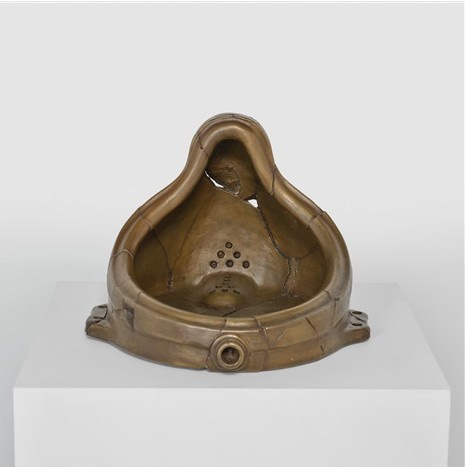
“The End of Art/Post-History: Danto argued that because Bidlo creates perfect copies of modern masters, he demonstrates that art has reached a state where the physical object is no longer paramount; rather, it is the interpretation.”22
#75. Some people just don’t know how to tell a joke.
ENVOI
For Hegel as others, the negation of the negation has another aspect: the ironic. Not simply the return of the repressed: its insistence on popping up like a jack-in-the-box. Whenever the critic imposes abstractions on reality the artist imposes reality on abstractions. Reality bites.
Like a joke well told, Fountain unfolds and unfolds again in Thought. A hundred years later, we’re still chuckling. Perhaps we’re chuckling for different reasons than a hundred years ago, just as we don’t, as a rule, admire a Masaccio nowadays for its clever commentary on the Trinity. Nothing’s been transfigured. Everything’s been transformed.
On the last page of the last chapter of the last volume of his collected works, Clement Greenberg concludes:
“I say that if you have to choose between life and happiness or art, remember always to choose life and happiness.”23
And why not choose both? The scandal of Duchamp, as far as the critics are concerned, is not that the shovel is transfigured into a work of art; it’s that the work of art remains a shovel for all that. Like Hegel said,
„Das Wahre ist der bacchantische Taumel.“
The True is the Bacchanalian frenzy. No reservations required.
WOID XXV-25
May 13, 2026
[Guillaume Apollinaire], « Le Cas de Richard Mutt », Mercure de France (June 16, 1918), p. 764. https://gallica.bnf.fr/ark:/12148/bpt6k201820t/f194.item ; consulted April 28, 2026
Georg Wilhelm Friedrich Hegel, Vorlesungen über die Ästhetik I. Auf der Grundlage der Werke von 1832-1845, Vol. I, neu editierte Ausgabe, Werke 13 (Suhrkamp 1986), p. 151.
Georg Wilhelm Friedrich Hegel, Philosophy of Mind. Translated from the Encyclopaedia of the Philosophical Sciences by William Wallace (Oxford: The Clarendon Press, 1894), §442, p. 61.
Enzyklopädie der philosophischen Wissenschaften im Grundrisse (Berlin: Heimann, 1870), §442, p. 377.
Vorlesungen über die Ästhetik I, p. 14.
Georg Wilhelm Friedrich Hegel, Aesthetics. Lectures on Fine Art. Translated by T. M. Knox. (Oxford: Clarendon Press, 1975), n. 1, p. 2.
Hanna Darlington Monaghan, “Greater Light on Nantucket” (Philadelphia: Hill House, 1973), quoted in Angela Mazaris, “’Evidence of things not seen:’ Greater Light as faith manifested,” Nantucket Historical Association, 2001 v. 50, no.1 (Winter 2001).
Georg Wilhelm Friedrich Hegel, Vorlesungen über die Ästhetik I, p. 17.
Gustavus Watts Cunningham, Thought and Reality in Hegel’s System (Longmans, Green, and Company, 1910), note 14. https://www.marxists.org/reference/archive/cunningham/thought-reality/ consulted April 26, 2026. The comment is in reference to James Black Baillie, whose English translation of Hegel’s Phenomenology of Mind was long considered the standard reference.
Clement Greenberg, “Avant-Garde and Kitsch” The Collected Essays and Criticism Volume 1: Perceptions and Judgments, 1939-1944, ed. John O’Brian (Chicago: University of Chicago Press, 1986).
“The Early Flemish Masters,” Arts Magazine, December 1960 in The Collected Essays and Criticism Volume 4: Modernism with a Vengeance, 1957-1969, ed. John O’Brian (Chicago: University of Chicago Press, 1986), p. 102.
See the editor’s note in Clement Greenberg, The Collected Essays and Criticism Volume 4, p. 316.
Clement Greenberg, “The Plight of Culture,” Art and Culture (Boston: Beacon Press), 1961, p. 31; see also “The Plight of Our Culture” [1953], The Collected Essays and Criticism Volume 3: Affirmations and Refusals, 1950-1956, ed. John O’Brian (University of Chicago Press, 1993), pp. 122-152; “The Plight of Our Culture. Industrialism and Class Mobility;” and “Work and Leisure under Industrialism: The Plight of our Culture Part II, Commentary (June and July, 1953).
Rosalind Krauss, “Sculpture in the Expanded Field,” October, Vol. 8 (Spring, 1979): pp. 30-44; “Grids,” October 9 (Summer, 1979): p. 50.
Arthur C. Danto, The Transfiguration of the Commonplace. A Philosophy of Art (Cambridge: Harvard University Press, 1981), p. 58.
Arthur Danto, “Ad Reinhardt,” Embodied Meanings : Critical Essays and Aesthetic Meditations (New York : Farrar Straus Giroux, 1994), p. 205; first published in The Nation, August 26 /September 2, 1991.
Clement Greenbert, “Avant-Garde and Kitsch,” The Collected Essays and Criticism, Vol. I: Perceptions and Judgments, 1939-1944, p. 12.
Pierre Bourdieu associates the social and economic hierarchisation fostered by the formation of an art public with Kantian theory. See Pierre Bourdieu, La Distinction. Critique sociale du jugement (Paris: Editions de Minuit), pp. 42-45, 583, etc.
Vorlesungen über die Geschichte der Philosophie [1836], Dritter Teil. Dritter Abschnitt. B. Kant.
On Hegel’s critique of Kant concerning this point, and its import for a sociology of art, see Pierre Bourdieu, La Distinction, p. 570, n. 10.
Clement Greenberg. “”Avant-Garde and Kitsch,” The Collected Essays and Criticism Volume 1, p. 17.
AI slop; collected May 11, 2026.
Clement Greenberg, “Interview Conducted by Lily Leino” [1969], The Collected Essays and Criticism Volume 4, p.314.