
[Continued]
I can’t imagine Marcel Proust beating up on anyone. Besides, this happened in the 10th arrondissement, a busy commercial and commuter section of Paris, not an ideal stomping ground for aesthetes.
More of a ground for stomping. This past Saturday, June 6, was the Nuit blanche in Paris, one of those anaesthetizing events I’ve called the Saturnalia: State-sponsored invitations to freely visit and enter social and cultural venues of all sorts, with the implication that these same events aren’t otherwise accessible.
A favor is being done. The Fondation Cartier is opening late, and there is an lighthearted event in front of the Holocaust Museum that “challenges our perception of archival images.” I assume the archival images being challenged are not Holocaust-related, that’s the kind of challenge that gets you arrested in Paris.
The Longue nuit, we are told, is « une grande fête de l’amour » because, as the artistic director informs us, « l’amour est ici revendiqué comme un véritable acte politique ». 1 “Here Love is asserted to be a genuine political act.”
I do not doubt it. Nor did the Catholic fascist thugs who this Saturday past assaulted the mayor of the 10th arondissement in front of the Church of Saint Laurent. The assault was in protest of the imputed politicization of the sacred space of Saint Laurent, though I wish the fascists had protested the language used to describe the event:
« Une installation sonore transforme des voix anonymes du monde entier en matière vivante mêlée aux éclairs, composant une cartographie sensible et poétique des désirs humains entre terre et ciel. »2
Not exactly Proust, but there are parallels. Proust, too, wanted for a while to believe the churches of France—he meant the great Gothic cathedrals—had once served a spiritual function that could only devolve into parody once they were turned over to godless, abstract aestheticism. He was reacting to the laws of 1887 that shifted the protection of the French cultural heritage to the State and away from the Church, followed by the Law on the Secularization of Church Property in 1905, the same law that so disturbs the christofascists nowadays.3 Proust, as early as 1904, had penned an article denouncing the “snobs” who, he prophesied, would someday pour into the great cultural centers for an aesthetic experience emptied of intelligibility.
Was Proust writing of the Venice Biennale? The Vegas glasstist Dale Chihuly has once again populated the sides of the Grand Canal with his giant vampire squids. I imagine the diligent glass workers of Murano feel about this the way voters in Manhattan feel about Schlock Jacksberg, the Tiktok candidate; the way ordinary Russians felt about apparatchiki; the way Italians feel about priests.
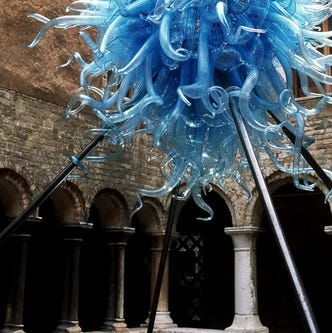
Proust’s article was warmly received by Maurice Barrès, the unapologetic National-Socialist; Proust himself continued to have doubts about all this: they are the doubts that propel Remembrance of Things Past until the final section where Proust, in the process of crossing a Venetian campo, realizes that the meaning of the past lies not in the aesthetic experience itself but in the process of extracting meanings from the memory of aesthetic experience. Hegel would have approved; so, too, Bergson, who was a major influence on Proust.4
Fortunately, it hasn’t taken as long for the cultural workers of Italy to grasp the dialectic. Once again a sciopero has been called for this June 12, a “General Strike for Culture,” or “of” Culture, or perhaps against Culture with a capital “C.” The organizers are a segment of those I defined earlier as
Comrades, in other terms. I like the fact that the strike is directed against l’under 35, meaning the wannabe youth that supposedly need to be encouraged to participate in Culture, but who in actuality provide its raw material, the primitive cultural labor to be accumulated.
What aligned most with my own thinking, however, was the Collective’s opening statement:
“It’s been long said that ‘Culture is the oil of Italy.’ However, we say culture is not oil, it is not a raw material one stumbles upon, that can be simply extracted and sold. Culture comes already ‘made:’ preserved, and passed on every day by a multitude of workers in the creative and cultural sectors.”
“La cultura è il petrolio d’Italia” si dice da anni. Noi diciamo invece che la cultura non è petrolio, perché non è una materia prima che ci ritroviamo per caso e che ci basta estrarre e vendere: la cultura viene “fatta”, tutelata e trasmessa ogni giorno dalla miriade di lavoratori e lavoratrici dei settori creativi e culturali.5
Culture, in other terms is not a raw material similar to the raw material sensations to be harvested according to the rules of the British Empiricists, guys like Adam Smith-yes-that-Adam-Smith. And now we’re back to our original problem: engaging a cultural space in its historic and social dimensions, instead of colonizing it. This is where the distinction between curating and staging comes in: between art as productive labor and art as capital.
To be Continued
WOID XXV-27d
June 12, 2026
Paris je t’aime, « Nuit Blanche 2026 à Paris : une 25e édition sous le signe de l’amour » ; https://parisjetaime.com/article/nuit-blanche-paris-a994 ; accessed June 8, 2026.
Paris.fr événements, « Marie-Luce Nadal. Sous la peau du ciel »; https://www.paris.fr/evenements/marie-luce-nadal-sous-la-peau-du-ciel-110240 ; accessed June 8, 2026.
Philippe Poirrier, L’Etat et la culture en France au XXe siècle (Paris : Le Livre de Poche 2006), pp. 22 sqq; Marcel Proust, “La Mort des Cathédrales,” Pastiches et Mélanges in Contre Sainte Beuve précédé de Pastiches et mélanges et suivi de Essais et articles (Paris : Gallimard, 1971), pp. 141-149.
Henri Bergson, Matière et mémoire : essai sur la relation du corps à l’esprit (Paris: F. Alcan, 1896); Paul Werner, “The Man with a Urinal. Marcel Duchamp at the Museum of Modern Art” WOID XXV-25 (May 13, 2026). https://theorangepress.substack.com/p/the-man-with-a-urinal
Assemblea Lavoratori del Spettacolo, “Piattaforma. Per uno sciopero della cultura.” https://vogliamotuttaltro.noblogs.org/files/2026/06/PIATTAFORMA_Per-uno-sciopero-della-cultura.pdf ; accessed June 11, 2026.